
| Home | Books | National Directory | Position Papers | Alan’s Blog | FAQ | New Stuff | Search |


|
The Founders Package
"The Books That Gave America Its Start"
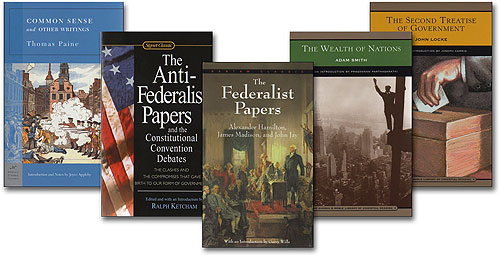
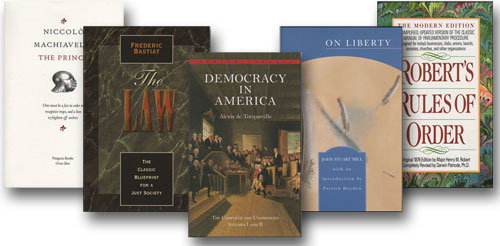
This is what the Founding Fathers read... and wrote. Now you can get America's most essential books -- Just a few easy clicks for a superb addition to your library Request a free full-color catalog SHORT AND SWEET:Thomas Paine: Common Sense Hamilton, Madison, Jay: The Federalist Papers Patrick Henry and others: The Anti-Federalist Papers Adam Smith: Wealth of Nations John Locke: The Second Treatise of Government The U.S. Constitution and The Declaration of Independence You'll cherish and enjoy this fine addition to your bookshelf, Niccolo Machiavelli: The Prince (1513) Frederick Bastiat: The Law (1850) Alexis de Tocqueville: Democracy in America (1832) John Stuart Mill: On Liberty (1859) Henry M. Robert: Roberts Rules of Order (1876)
Add this set of classics to your personal library— The most insightful, fundamental thinking ever produced Order any of these items separately:
Thomas Paine: Common Sense At the time, this land was filled with people proud to be British subjects, who believed Britain had the greatest government in the world, and they revered and admired the king. Others felt distinctly Dutch, or French, or Spanish... in touch with their European roots. Then along comes Paine who says you don't need England or your old ties, you don't need parliament or a monarch, all you need is America and freedom. People thought of themselves as Virginians or Georgians or whatever colony they were from. Paine addressed them as Americans, part of a greater whole, and the idea took hold with a vengeance. It was the most wildly successful book of its time, and maybe, more than anything else, was responsible for the founding of the Union. It introduced a paradigm shift in how people in the fledgling nation thought of themselves. Though completely radical, it seemed perfectly natural, a mere matter of common sense. Paine's words were the birth mother of a new nation, and the very essence of this set of Founder's thoughts. Common Sense has been in print continuously since its original publication, and the original manuscript still exists, housed in Philadelphia. Our modern edition, like all the books in this collection, is typeset in easy-to-read modern American English.
Adam Smith: An Inquiry into the Nature and Causes of the Wealth of Nations (1776) Of his three main themes, his first took the world by storm -- self-interest drives human activity, it's OK to pursue your own self-interest, and markets work best when people -- consumers -- are free to make choices. Self-interest isn't greedy, cold or uncompassionate (as leftists often believe and many schools teach to this day) -- it is the road to prosperity and abundance. Everyone works hard to get ahead, because it's in their best interest to do so. Everything that interferes with this slows us down. Smith coupled this with an understanding that freedom of trade was a cornerstone of economic growth. The less government interfered with trade, the more business would thrive (and then government would get its larger share). Finally, he described how division of labor is what fueled robust production, and built the wealth of nations. Along the way he pointed out that a nation's wealth is not fixed, and so doesn't have to be hoarded (in fact, it cannot be hoarded) -- it depends on the activity of its people. In these days before television, Smith's 900-page book sold for the equivalent of four weeks pay, and was devoured as an instant best seller. We offer a slightly condensed paperback that is easier to read, brings out all the key insights in Smith's original words, and gives the reader a deep understanding of how and why capitalism and freedom thrive.
Hamilton, Madison, Jay: The Federalist Papers The clearest expressions of the need for an armed public are contained in this book, along with most other major issues of the day. A central government was needed, they said, to handle the matters the individual colonies could not, like defense of the borders, the role of armed forces, matters of commerce between the states and more. It is perhaps the most quoted book of this collection, when it comes to determining what the Founders really thought and meant when they drafted the U.S. Constitution. It is also controversial, because many people believe it deliberately laid the groundwork for an over-powerful, nearly tyrannical central federal government we see today. See the next book for more on that viewpoint.
Morton Borden’s collected documents: The Anti-Federalist Papers Along with others, he succeeded in convincing the Colonists that a central government, without explicit limits on its power, was a goal not worth pursuing.
John Locke: The Second Treatise of Government In a time of monarchies, with rulers and subjects as the de facto norm, these were radical ideas, but they sure made sense and they had broad appeal. Locke challenged the existing order and perhaps single-handedly made the American system and the Colonial revolution possible, by providing its philosophical framework.
Post-Revolutionary Books The Founders Package is rounded out with writings that grew out of the upheaval in America. While the first half of the set lays the groundwork for what we Americans accomplished, the second half of the set explores the results of those amazing times. Bastiat, DeToqueville and Mill eloquently summed up what had happened here. They put into words what the Founders had put into action. For good measure, I threw in Machiavelli who preceded it all by more than two centuries -- talk about being ahead of your time! -- and Roberts, who 100 years later made it easy to replicate the system that made America grow, with his timeless classic, Robert's Rules of Order -- a book I use to this day when I run meetings.
The Founders Package belongs in every citizen's well-stocked library. With one easy decision, you own the reasons America thrives. Invest in yourself. Complete 11 book set, only $71.67 +S&H
Request a free full-color catalog
Encourage politicians to pass more laws...
|


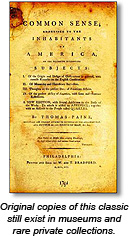 Common Sense came out of the blue -- there had never been anything like it. Historians remark how it stands out as a fundamental change in the way America developed.
on gun laws and other topics.
|